
Let’s get one thing straight: this list is technically an opinion, but it’s an informed one. I’ve spent hundreds of hours studying and playing roguelikes, and even more dying in them. You might not agree with every pick, and that’s fine. But before you grab your pitchfork, hear me out. Just give me a chance to explain why these are, in my view, the nine best roguelike games ever made.
For reasons I still can’t explain, I’m addicted to challenge. If a game fights back, I’m in. That’s why the roguelike genre hooked me so hard. When it’s designed right, a roguelike gives you something most games don’t: the feeling that you’re actually getting better. It doesn’t matter if it’s a pure roguelike or a roguelite cousin. At their core, both are about learning, adapting, and deciding what to do next time when everything inevitably falls apart.
A good game, for me, isn’t about graphics or music. It’s about design. You can make a game that looks like a Roblox mod and, if the systems are solid, I’ll happily lose a hundred hours to it. That’s the magic of roguelikes done right: great design means infinite possibility. Every run feels familiar but never identical. Every decision carries weight. And that’s what this list is about, the peak of roguelike and roguelite design, the games that understand how to make failure feel fun.
You will find other lists that read like a press release crossed with fan mail. Cute. This one is not that. I look at games from the point of view of design, not hype. These nine passed the test: they make you learn, adapt, and come back wanting one more run, over and over again.
What Actually Defines a Roguelike?
There are a lot of theories floating around about what makes a roguelike a roguelike. Some people pull out the Berlin Interpretation like it’s a sacred scroll. Others say anything that’s hard and random counts. And then there are the takes about “great music” being the key to a good roguelike. Sure, music helps. But if your soundtrack is doing the heavy lifting, your game probably isn’t.
From a design perspective, roguelikes thrive on one thing: the feedback loop between player skill and system reaction. You act, the game reacts, and you learn something new every time. That’s what keeps you hooked, not the soundtrack or the graphics, but the conversation between you and the mechanics.
To me, a good roguelike nails three fundamentals:
-
Meaningful failure. Losing should teach you something. If you die and immediately understand why, that’s good design.
-
Strategic flexibility. Every run should make you rethink your approach. The game gives you tools; you decide how to break it.
-
Endless discovery. Systems overlap in ways that surprise you, creating new strategies even after hundreds of hours.
Everything else, visuals, music, voice acting, is dressing. Nice to have, not the reason you keep coming back. The best roguelikes respect your intelligence by making every run a lesson, not a loop. That’s the difference between fun and addictive fun.
The 9 Best Roguelike Games: An Objectively Game Designer Correct Ranking

9. FTL: Faster Than Light | Subset Games | PC, Mac, iPad
FTL is the perfect reminder that graphics mean almost nothing when the design is airtight. It isn’t pretty, and that’s fine, because the magic lives in its systems. Every run feels like juggling a dozen spinning plates while the room catches fire, literally. You’re not just manning weapons; you’re running a starship, managing oxygen, rerouting power, and gambling your crew’s lives on desperate decisions.
What makes it special is trust. FTL never treats you like an idiot. It assumes you’ll learn from your failures, make smarter calls, and get better with every doomed jump. The difficulty can be brutal, but it’s honest. Every loss carries a lesson, every small victory feels earned, and every restart comes with new possibilities you didn’t see before.
For ten bucks, it offers a level of tension and satisfaction most AAA studios can’t touch. The combat is sharp, the micromanagement deep, and the feedback loop flawless. It’s a small game about big decisions, and it proves that a well-designed system will always outshine pretty pixels.
8. Slay the Spire | Mega Crit | PC, Consoles, Mobile
Slay the Spire is the rare game that makes you laugh alone at your desk, not because it’s funny, but because your deck just exploded into the perfect combo, the kind of synergy that feels like you accidentally hacked probability itself. It’s that unpredictable emotion that keeps you hooked, knowing the same combo might never happen again, but you’ll spend the next dozen runs trying to chase that high anyway.
This game is where deckbuilding meets roguelike logic at its purest: every choice echoes through the next ten floors. Pick a card. Add a relic. Take a risk. Each decision feels small, yet the consequences ripple. The beauty of Slay the Spire isn’t in flashy mechanics or heavy storytelling, it’s in how much agency it gives you within a completely volatile system. You build your deck, you build your downfall, and you learn.
As a designer, what stands out is how cleanly it teaches you to think. It’s not about memorizing optimal moves; it’s about understanding trade-offs. Attack or defend? Push damage or survive another turn? The right call depends on what the game gave you, not what you wanted. That’s elegant design, forcing adaptation without ever feeling unfair.
Slay the Spire is more than a genre blend. It’s the blueprint. It inspired an entire wave of “Spire-likes,” but none have matched its precision. It’s proof that when randomness and strategy are balanced perfectly, you don’t need spectacle; you just need one more run.
7. PokéRogue | Fan Project | Browser
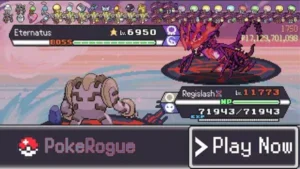
PokéRogue is the best kind of fan experiment, the one that cuts out everything unnecessary and somehow makes the core loop even better. No storylines, no overworld, no wandering around tall grass pretending to care about side quests. It’s just battles, pure and relentless. The moment you start, it feels like someone distilled Pokémon into its raw mechanical essence and sprinkled roguelike spice over the top.
Each run begins with simple decisions that spiral into obsession. You build a starting team with point restrictions, then fight through floors of wild Pokémon and trainers, balancing stat buffs, item choices, and risk. Win ten fights, clear a floor, heal, repeat. The loop is dangerously smooth. Within minutes, you’re thinking in probabilities and damage curves instead of nostalgia. It’s Pokémon for players who love the system, not just the mascot.
What makes PokéRogue brilliant from a design perspective is how it recontextualizes strategy. Movesets change, buffs persist between fights, and items have roguelike implications, Lures, Exp All, Mega Rings, all feeding into layered decision-making. You start to see your Pokémon not as characters but as evolving builds in a living run. The moment you lose a team, you’re already planning how to do it better next time. That’s the genre’s heartbeat.
And yes, shinies and gachapon eggs exist, but they’re not just fan-service. They’re risk mechanics wrapped in Pokémon glitter, offering more ways to gamble with your next advantage. The whole game is a conversation between planning and chaos, exactly what a roguelike should be.
PokéRogue is proof that good design doesn’t need official branding. It just needs focus, feedback, and the courage to strip away everything except the fun.
6. Enter the Gungeon | Dodge Roll | PC, Consoles
Enter the Gungeon looks like a cartoon, plays like a bullet ballet, and punishes you like it’s doing you a favor. It’s chaotic, silly, and somehow deeply precise, a shooter that remembers what arcade design used to feel like before things got cinematic. The dodge roll, your lifeline and your curse, defines the entire rhythm. It’s not a gimmick. It’s a philosophy: timing over panic, control over chaos. Once it clicks, you start seeing patterns where there used to be noise.
Enemy design in Gungeon deserves a study of its own. Each floor feels like a mixtape of bullet patterns and weird personality. Floating iron maidens, teleporting wizards, angry bullets with guns, it sounds ridiculous, and it is, but it’s also balanced. You can read attacks, plan routes, and survive purely through skill. The game never lies to you. When you die, it’s because you blinked.
What makes Gungeon smart is how it uses roguelike systems to support, not suffocate, the shooter core. Every floor is a shuffle of handcrafted rooms, so the structure stays tight while still feeling fresh. Loot and drops are random, sure, but not arbitrary. You adapt to the run you’re given, not the one you imagined. That’s where the fun hides, in improvising.
As a design piece, Gungeon is the perfect example of synergy done right. Its systems talk to each other. Its rules make sense. And even after hours, it keeps finding ways to surprise you. Because in the end, nothing says “well-designed roguelike” quite like dying to a sentient bullet and still smiling about it.

5. Hades II | Supergiant Games | PC, Switch (Switch 2), others later
Hades II feels like watching a master class from a studio that already perfected the format once and still somehow decided to outdo itself. This is Supergiant at its peak, confident, layered, and unapologetically complex, but always in ways that serve the player. Where most sequels bloat, Hades II builds. Every run introduces new systems, new stories, and new ways to fail smarter. Fifty hours in, you’re still unlocking something that changes how you play. That’s not just content; that’s design discipline.
At its core, Hades II keeps the soul of its predecessor: tight combat, sharp feedback, and that hypnotic loop of “just one more run.” But now it doubles the structure with two full progression paths, one plunging into Tartarus to chase Chronos, another climbing toward Olympus to break his siege. The result? Two entire ecosystems of encounters that keep the experience perpetually fresh. When one boss breaks your will, you pivot to the other path. That’s pacing as design, tension without burnout.
Supergiant’s brilliance is that every new layer feels earned. Mechanics stack at a deliberate rhythm, never overwhelming, always intriguing. The combat flow is still perfect, readable, reactive, and full of expression, but the tactical depth has quietly multiplied. It’s a designer’s dream: a system that rewards both experimentation and mastery.
And sure, it’s beautiful. The art, the music, the dialogue, all stunning. But what matters most is that it never forgets the foundation: a roguelike should make you feel clever for surviving. Hades II does that relentlessly. It’s not just one of the best roguelites ever made, it’s proof that iteration, when done with intent, is innovation.

4. Risk of Rain 2 | Hopoo Games | Gearbox Publishing
Risk of Rain 2 doesn’t ask for your time; it steals it with interest. What starts as a straightforward third-person shooter quickly mutates into a chaos simulator where numbers explode, bosses scream, and your brain whispers one more run before you even realize what’s happening. It’s the definition of a perfect loop: responsive action, endlessly stacking items, and a constant sense that you’re seconds away from either godhood or total collapse.
The core idea is deceptively clean. You drop onto a planet, fight off waves of increasingly nasty creatures, and grab loot that snowballs your power. Items stack infinitely, so the longer you last, the wilder your build becomes. One run, you’re summoning black holes; the next, every bullet explodes like a fireworks finale. That unpredictability is what makes it funny, not in a comedic way, but in that “I can’t believe this is working” kind of way that every great roguelike nails.
As a design exercise, Risk of Rain 2 does something brilliant: it makes time your enemy. The longer you play, the harder everything gets. It’s a literal ticking clock of tension that forces you to balance exploration against survival. Do you hunt for more chests, or sprint for the teleporter? Either choice could save or end your run. That’s elegant pacing, not random chaos.
The six survivor classes push this further. Each one feels distinct, not just in stats, but in rhythm. Whether you’re dashing through mobs as the Huntress or dropping orbital strikes as the Engineer, the combat remains clean, tactile, and deliberate. It’s no small feat that a game this fast never feels sloppy.
Risk of Rain 2 thrives because it trusts you to build your own story out of systems. You learn the rules, you bend them, and eventually you break them, all while laughing at the absurdity of it. That’s what makes it a top-tier roguelike: it’s both a power fantasy and a study in self-control.

3. Dead Cells | Motion Twin | PC, Consoles, Switch, Mobile
Dead Cells is that rare kind of game that doesn’t just reward movement, it worships it. It’s a kinetic storm of precision, speed, and calculated risk where every roll, jump, and slash feels like it was handcrafted to keep your adrenaline just below panic. You’re a headless prisoner, endlessly reborn, endlessly punished, and somehow endlessly entertained. The story barely matters. The design does.
At its core, Dead Cells is a study in how far momentum can carry a player. Every mechanic pushes you forward. Kill enemies fast and you move faster. Chain attacks and you become untouchable. The game doesn’t punish aggression; it thrives on it. You learn by moving, not by waiting. That’s what separates it from other roguelites, it treats hesitation as failure and style as survival.
From a design perspective, it’s brilliant in how it fuses readability and chaos. You can parse every animation, every telegraph, even when the screen is exploding with color. The procedural levels feel handcrafted because they’re built from tight modular pieces that always make sense. Weapons and gadgets constantly reshuffle the rhythm of combat, and each new run subtly teaches you a new tempo. It’s less about memorizing patterns and more about mastering flow.
Dead Cells is also a quiet masterclass in persistence design. The upgrades you keep between runs never make the game easier, just richer, new paths, new strategies, new tools to fail with. The game doesn’t hand out power; it hands out possibility.
What makes it timeless isn’t its art (though it’s gorgeous) or its soundtrack (which slaps); it’s that perfect loop of motion, discovery, and discipline. Dead Cells doesn’t waste your time. It just asks if you can keep up.

2. Balatro | LocalThunk | PC, Consoles, Mobile
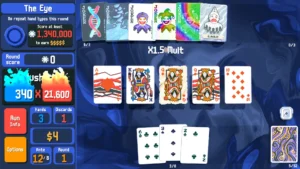
Balatro is what happens when a designer looks at poker and decides it just isn’t unhinged enough. On the surface, it’s simple: play hands, chase multipliers, beat the blind. But beneath that, it’s a probability playground disguised as a roguelike. Every hand is a small experiment, every run a statistical fever dream where you push your luck until math starts cheering for you.
It’s easy to underestimate Balatro because it has no combat, no monsters, no narrative stakes. What it does have is systems layered so cleanly that the entire game becomes an elegant loop of discovery and greed. Each ante pushes you toward higher targets, and with a limited number of plays, you learn to squeeze every multiplier, discard, and Joker ability until you’re operating on instinct more than logic. It’s the rare roguelike that feels strategic and chaotic at once.
Jokers are the real stars here. They’re not just modifiers, they’re identity cards. The moment you pick one, your run shifts tone. Maybe you chase wilds. Maybe you go negative. Perhaps you build a hand so cursed it breaks your own scoring model. And when it works, that explosion of points across the screen is the dopamine spike of the century.
Balatro nails what great roguelikes all share: the fun lives in the experiment. Losing doesn’t sting; it instructs. Each failed run gives you another idea, another variable to test. It’s absurdly accessible even if you barely know poker, and yet deep enough to consume your nights if you love tinkering with systems. It’s clean design pretending to be chaos, the best kind.

1. The Binding of Isaac: Rebirth | Nicalis | PC, Consoles, Switch, iOS
The Binding of Isaac: Rebirth is the roguelike that shouldn’t work, and yet, it’s still the one everyone ends up comparing the rest to. It’s gross, darkly funny, and deeply mechanical, turning childhood trauma into a loop of discovery, punishment, and absurd power fantasies. One minute you’re crying on poop monsters, the next you’re a floating abomination firing brimstone lasers through walls. Somehow, it all clicks.
The beauty of Isaac isn’t in the visuals or the story; it’s in how the systems collide. Every run mutates faster than you can predict. Items stack, fuse, and twist your build into something barely recognizable. A single pickup can change the physics of your tears, the flow of combat, or the way you think about positioning. By the time you hit the second floor, you’re already piloting a new creature built out of your own bad decisions. That’s not randomness, that’s design mastery disguised as chaos.
What Isaac nails, better than almost any game since, is the idea of earned absurdity. It provides you with hundreds of items, but forces you to learn how they interact through trial and error. It teaches you by humiliating you, and you love it for that. When you finally pull off a synergy that breaks the run, it feels less like luck and more like payback for all the brutal runs before it.
Rebirth’s expansions, from Afterbirth to Repentance, only made it denser without ever losing the heartbeat: risk, reward, and self-inflicted suffering. It’s unpredictable, replayable, and endlessly revealing. You think you’ve seen everything, and then some new nightmare shows up to humble you all over again.
The Binding of Isaac is more than a game; it’s a design thesis on chaos management. It never treats you like a fool. It just asks if you’re willing to keep learning while everything around you falls apart.
What is your favorite roguelike?
If there’s one thing every roguelike on this list has in common, it’s respect for the player’s brain. None of them rely on cheap tricks or filler; they give you systems to learn, patterns to master, and room to fail in interesting ways. That’s what good design looks like. It’s not about punishing you for losing; it’s about teaching you something every time you do.
What makes the genre so powerful is that it turns you into the progression system. The more you play, the sharper you get. Whether you’re chaining combos in Dead Cells, bending probability in Balatro, or crying your way through Isaac’s nightmare basement, the process is the same: experiment, adapt, improve, repeat. The magic isn’t in the graphics or the loot; it’s in that constant conversation between the player and the game.
Roguelikes aren’t here to comfort you. They’re here to challenge you, to expose your bad habits, and to make you grin when you finally pull off something absurdly impossible. That’s the beauty of the genre, and why, after all these years, it’s still the purest expression of what makes games fun.